|
.
Click
the video above for a little background music while you read my
final thought this month..
.
Hello Metro family and friends! I hope you had a great summer. As the fall crisp air takes over, and the days get shorter, I just want to thank you for reading and supporting the McCarty Metro over the years.
|

|
After a cancelled
trip last month because of a medical issue, Margaret and I were
able to connect with Gina and Larry on an Ohio, Indiana,
Illinois road trip which allowed us to see trolls, go to a
casino, and visit Casey, Illinois which is a Roadside America
treasure trove with 30+ oversized objects, and 12 of the worlds
largest items on display in the streets of Casey. We had a great
time with lots of laughs. Can't wait until the next one...
The McCarty Metro Vegas Baby Vegas trip
plans have been started. So far, we are planning for January
9-14, 2026. We always have such a great time. If you are interested in going, we all make our individual arrangements (flight and hotel), but we all stay in the Harrah's / Flamingo mid-strip area. Should be a blast!
|
September means
it's the
16th year of the McCarty Metro NFL Pigskin Pickem game. Rambo will try to win back to back titles (He must be stopped). Make sure you try to drop by weekly to the Metro and make your picks. You don't have to know anything about football or the NFL to play. It is a fun season, and the playoffs and Super Bowl are a blast. I hope you will consider joining us. The first game of the season is on
Wednesday, September 9, so make sure to get your picks in by that kickoff!
Thank you for
those who reached out over the past few months praying for me to
beat cancer. So far... So good! I would like you all to please
keep my wife Margaret in your thoughts and prayers as she is
getting a full knee replacement this month. After over 30 years
walking her postal route, she needs this to enjoy some pain-free
activities ("scrapbooking"). I promise to take really
good care of her as she has done for me in the past.
The final thought I leave you is a story about a
young man named Zeke who is starting his senior year in high
school with a great attitude. Enjoy!
..
|
Zeke
"As
school begins for our high school senior, many of
the graduation preparation has already started for
them. Earlier this week we went to get Zeke’s
senior yearbook pictures.
On
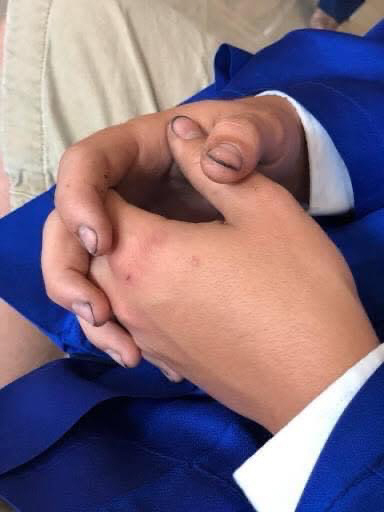
the way, I noticed his hands. Working hands. Hands
that look familiarly like my dad’s work-stained
hands and like Brandon’s in the early years of
our marriage. I told him not to worry about it
because they were doing headshots.
I
was wrong.
As
we sat in line, I notice kids in letterman jackets
with their class rings. And I notice Zeke’s
stained hands. I began to tear up. Have I given
him everything a parent should give to their child
as he has grown up? He worked out in the heat,
30-40 hours a week during the summer. He didn’t
want a class ring or a letterman jacket. He
didn’t get a new car. The mommy comparison game
tells me I didn’t show him how much I love him
with things.
I
left there feeling bad about myself and how we
have raised our son. I’ve been reflecting the
last few days and crying a lot, honestly. I
apologized to Zeke and he laughed at me. He said,
“Why are you sorry? Because you’ve taught me
to work hard for things I want? Because I know the
value of a dollar? Because I’m not going to
think that I deserve to have everything I
want?”
And
my sister reminded me that the best things in life
aren’t things, but relationships, and any
shortfalls in my parenting are covered by God’s
grace. So mama’s, if you’re struggling with
the parenting comparison game, just know that God
gave you the babies you have because he wanted
you, YOU, to be their mama. Not someone
else.
I
am beyond proud of Zeke, who has taken his brother
shopping for a canoe today, using his money that
he earned in a vehicle that he fixed with his own
hands and gas he paid for by himself.
I’m
not ready for Zeke to grow up, but I think he’s
well on his way."
|
|
|
Here's
to all the hard working Zeke's in our world.

|
|
|
|